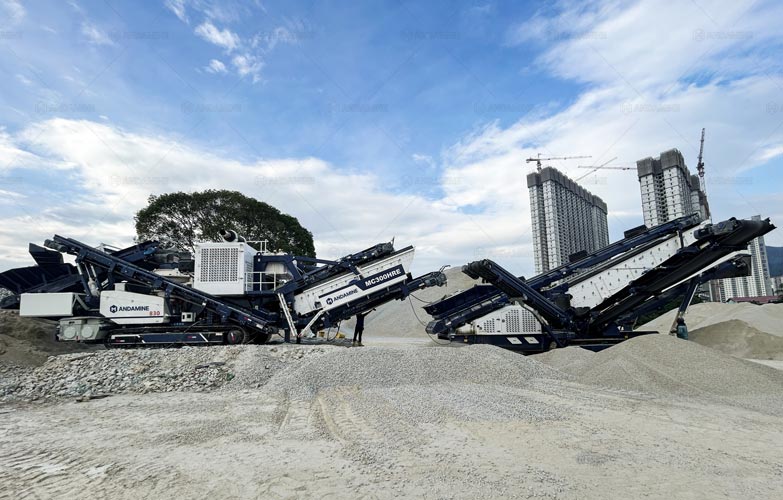
Large aggregate projects require more than a high-capacity crusher. Quarrying, mining, highway construction, dam building, and major infrastructure projects often involve thousands or millions of tonnes of material, making equipment selection a long-term production decision. A properly configured aggregate crushing plant should match the material characteristics, required output, site conditions, and project schedule rather than being selected only by its maximum rated capacity.
For a large stone crushing plant, the complete production process needs to be considered from feeding and primary crushing to secondary or tertiary crushing, screening, and stockpiling. The right rock crusher is only one part of the system. If one stage has insufficient capacity or the equipment is poorly matched, the entire production line can operate below its potential.
Start With The Project's Production Requirements
The first step is to define how much aggregate the project actually needs. A production target should be calculated from the total material requirement, operating days, working hours, and expected equipment availability.
For example, a project requiring 1 million tonnes of aggregate over 12 months should not simply divide the annual requirement by the theoretical operating hours. Planned maintenance, material changes, weather interruptions, and other downtime should also be considered when determining the required plant capacity.
Consider Both Peak And Average Production
Large projects may have periods of significantly higher aggregate demand. If the plant is selected only according to average production, it may become a bottleneck during peak construction stages.
Before selecting an aggregate crushing plant(planta trituradora de agregados), establish:
- Total aggregate requirement
- Required production per hour
- Expected operating hours per day
- Number of working days per year
- Required aggregate sizes
- Expected equipment utilization
- Future production increases
Match The Crusher To The Raw Material
Rock characteristics directly influence crusher selection. Hardness, abrasiveness, moisture content, feed size, and material structure all affect crushing performance and wear consumption.
Primary Crushing
Large rocks normally require a primary crusher capable of accepting the maximum feed size from blasting or excavation. Jaw crushers are widely used for primary crushing because they can handle large and hard feed materials.
The selected rock crusher should have sufficient feed opening and capacity for the expected material. Undersizing the primary crusher can create a bottleneck that limits the production of the entire plant.
Secondary And Tertiary Crushing
After primary reduction, secondary and tertiary crushers can further reduce the material and produce more controlled aggregate sizes. Cone crushers are commonly considered when processing hard and abrasive rock and when a consistent final product is required.
The crusher configuration should be based on the final product specifications rather than simply adding more crushing stages. Additional stages increase equipment, energy, maintenance, and installation requirements.
Design The Complete Crushing Circuit
A high-capacity stone crushing plant(planta chancadora de piedra) should be evaluated as an integrated system. The feeder, crushers, screens, conveyors, and stockpiles need to maintain a balanced material flow.
A typical large-scale process may include:
- Raw material loading
- Controlled feeding
- Primary crushing
- Secondary or tertiary crushing
- Screening and classification
- Oversize material recirculation
- Finished aggregate stockpiling
If the screen cannot process the output from the crusher, increasing crusher capacity will not necessarily increase final production. Similarly, insufficient conveyor capacity can restrict material movement between stages.
Pay Attention To The Crushing Ratio
The reduction ratio between feed material and final product influences how many crushing stages are required. A large reduction in one stage may not always be practical or economical.
Engineers should evaluate the required feed size, intermediate product size, final aggregate specifications, and crusher capabilities together when designing the circuit.
Evaluate Screening And Product Quality
Large aggregate projects often require several finished products rather than one uniform aggregate size. The screening system therefore has a direct influence on both product quality and production efficiency.
Before selecting an aggregate crushing plant, identify the required product specifications and determine how much material is needed in each size fraction.
A suitable screening system should provide adequate capacity without allowing excessive oversize or undersize material to enter the wrong stockpile. If several aggregate products are required, the number of screen decks and conveyor discharge points should be planned accordingly.
Consider Site Conditions And Logistics
Equipment selection should also reflect where the plant will operate. A quarry with permanent access and sufficient space may support a stationary stone crushing plant, while a project involving multiple extraction areas may benefit from a mobile or modular configuration.
Important site factors include:
- Available installation area
- Road and transportation access
- Terrain and ground conditions
- Power availability
- Distance between extraction and processing areas
- Environmental and dust-control requirements
- Ease of equipment relocation
For remote projects, logistics can have a major influence on operating costs. Moving raw material over long distances may require additional trucks, fuel, and infrastructure, while a mobile crushing solution can potentially bring processing closer to the extraction area.
Compare Total Cost, Not Just Equipment Price
The purchase price of a rock crusher(trituradora de rocas) or complete plant is only one part of the investment. Large aggregate projects should consider the total cost of ownership throughout the expected operating period.
Key Cost Factors
- Initial equipment investment
- Installation and commissioning
- Energy or fuel consumption
- Wear parts and replacement frequency
- Routine maintenance
- Labor requirements
- Transportation and relocation
- Downtime and spare-parts availability
A lower initial equipment price does not necessarily result in lower project costs if the plant has high energy consumption, frequent maintenance requirements, or insufficient production capacity.
Plan For Maintenance And Future Expansion
Large aggregate projects depend on continuous production, so maintenance accessibility should be considered during equipment selection. Components subject to regular wear should be easy to inspect and replace, and critical spare parts should be available within a practical timeframe.
It is also worth considering whether the aggregate crushing plant can be expanded or reconfigured later. A project may initially require two aggregate sizes but add more products as construction progresses. A modular layout can provide additional flexibility for future changes.
Build The Equipment Selection Around The Entire Project
Selecting equipment for a large aggregate project is ultimately a process-design decision rather than a single-machine purchase. Production requirements, material characteristics, crushing stages, screening capacity, site logistics, operating costs, maintenance, and future expansion should all be evaluated together.
The most suitable stone crushing plant is the one whose complete production system matches the project's actual requirements. By selecting the feeder, rock crusher, screens, conveyors, and supporting equipment as a coordinated system, contractors can establish a more stable production process and make better use of their investment throughout the project lifecycle.

Comments
No comments yet. Be the first to react!